Pages

Parallel and series circuits

Charge: electron = 1.602 X 10^-19 coulombs (C)
Fundamental property of matter - like mass & length.
positive, or negative charge


Current - the rate at which charge flows through a given surface

Ampere current unit
 6.241×10^18 electrons (or one coulomb) per second = one ampere

Voltage = electrical potential difference between two points

 units = volts =  joules / coulomb

Voltage = the work done per unit charge against a static electric field to move the charge between two points. 


A voltmeter can be used to measure the voltage (or potential difference) between two points in a system; usually a common reference potential such as the ground of the system is used as one of the points. 

Conductor - material that permits the flow of electricity


Resistor - resists the flow of electricity


Ohm (symbol: Ω) is the SI unit of electrical resistance


1 Ohm = the resistance between two points of a conductor when a constant potential difference of 1.0 volt, applied to these points, produces in the conductor a current of 1.0 ampere


Ohm's Law:  V = iR

Voltage = Current * resistance


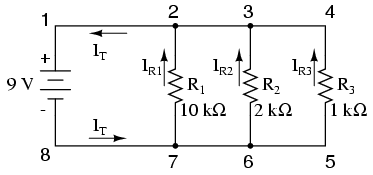
Kirchoff's current law - Conservation of charge


The current entering any point = the current leaving the point
 i2 + i3 = i1 + i4


Kirchoff's voltage law - Conservation of energy
The sum of all the voltages around the loop= zero
 v1 + v2 + v3 - vin = 0
or
Vin = V1 + V2 + V3

 ~~~~~~~~~~~~~~~~~~~~~~~~~~~~~~~~~~~~~~~~~~~~~~~~~~~~~~~~~~~~~~~~~~~~~~~~
 Resistors in series  -


~~~~~~~~~~~~~~~~~~~~~~~~~~~~~~~~~~~~~~~~~~~~~~~~~~~~~~~~~~~
Resistors in Parallel


Data Acquisition & Control
Data Acquisition -
 take data, like measuring pressure, force, temperature, etc.  Writing a number down to represent a physical quantity.


Control - Use electrical outputs to control a physical property (like Temperature, or pressure) in a system.    

Thermistor -

A thermistor is a type of resistor whose resistance varies with Temperature

Assuming, as a first-order approximation, that the relationship between resistance and temperature is linear, then:
\Delta R=k\Delta T \,
where
\Delta R = change in resistance
\Delta T = change in temperature
k = first-order temperature coefficient of resistance


 Strain gauge: R varies with Strain 
(wires get thinner and longer with strain, this increases resistance)


Analog Information
 - the actual physical voltage that varies proportionately with a physical property such as temperature, or pressure, or sound.  Analog signals are smooth, with infinite resolution - not pixilated.

Digital information - the number that shows up on your computer screen to represent the physical voltage.  The number on your screen is "pixilated", it does not exactly match the physical entity you are trying to measure.

Analog to Digital Converter - ADC -
Analog-to-digital converter (ADC) is a device which can convert the actual analogue voltage into digital numbers on a multimeter or on a computer.


https://www.youtube.com/watch?v=VBDoT8o4q00


Bits
 - How a computer stores information.

A single bit can be either a 0 or a 1

ADC has n-bit resolution (8 bit, 12 bit, 16 bit, 24 bits etc.) higher-resolution ADC = a smaller step size
Step size = the smallest change between digital numbers


Example: 8 bits, representing 0-5V.
the range is divided into 2^8=256 steps (from 0 – 255)
Step size = 5/(2^N-1) = 5/255 = 0.01961V or 19.1mV


 ~~~~~~~~~~~~~~~~~~~~~~~~~~~~~~~~~~~~~~~~~~~~~~~~~~~~~~~~~~~~~~~~~~~~~~
Charge: electron = 1.602 X 10^-19 coulombs (C)
Fundamental property of matter - like mass & length.
positive, or negative charge

Lab - see D2L


Electricity!

Take a walk through history.  
You will learn concepts in the same order that humanity has discovered them in.  Imagine you lived 200 years ago.  What types of electricity existed in nature for you to discover?


Static Electricity: Two surfaces, one with high resistance (insulator).  Materials with weakly bound electrons tend to lose them while materials with sparsely filled outer shells tend to gain them. -  Triboelectric effect.

Challenge:  
Imagine it is 200 years ago.   You have been playing around with static electricity, and you want to play a trick (on your brother, sister, room-mate etc.).  How do you create the largest shock?  Is it possible to store up what is making that shock somehow?

Questions to ask:

  • Rubbing which materials together produces the most static electricity?
  • What materials produce the best shocks?
  • what materials prevent you from getting shocked?

Before humans knew about atoms, electrons, and protons, we knew about static electricity.  By asking the above simple questions we could start understanding concepts such as insulators and conductors. 

What happens when you create a layered container with
conductor→insulator→conductor?


Leyden Jar:
A Leyden jar, or Leiden jar, is a device that "stores" static electricity between two electrodes on the inside and outside of a glass jar. It was the original form of a capacitor (originally known as a "condenser").


It was invented independently by German cleric Ewald Georg von Kleist on 11 October 1745 and by Dutch scientist Pieter van Musschenbroek of Leiden (Leyden) in 1745–1746.[1] The invention was named for the city.


The Leyden jar was used to conduct many early experiments in electricity, and its discovery was of fundamental importance in the study of electricity.


Lightning: Created from electrically charged regions within  clouds.


Lightning rod experiments

In 1752, Franklin proposed an experiment with conductive rods to attract lightning to a Leyden jar, an early form of capacitor.


Such an experiment was carried out in May 1752 at Marly-la-Ville in northern France by Thomas-François Dalibard. An attempt to replicate the experiment killed Georg Wilhelm Richmann in Saint Petersburg in August 1753, thought to be the victim of ball lightning. Franklin himself conducted the experiment in June 1752, supposedly on the top of the spire on Christ Church in Philadelphia.


Electrical Current: Electrons moving in a wire, or ions in an electrolyte.


Ampere (A), Amp, unit of electric current.  It's the amount of electric charge passing through a conductor.


Ohm's Law:

http://phet.colorado.edu/sims/ohms-law/ohms-law_en.html


Induction motor:


How magnets work:


Electromagnetism:

Electromagnetism, or the electromagnetic force is one of the four fundamental interactions in nature, (the other three being the strong interaction, the weak interaction, and gravitation.) 
 

Originally electricity and magnetism were thought of as two separate forces. This view changed, however, with the publication of James Clerk Maxwell's 1873 Treatise on Electricity and Magnetism in which the interactions of positive and negative charges were shown to be regulated by one force.


.
There are four main effects resulting from these interactions, all of which have been clearly demonstrated by experiments:


 1.   Electric charges attract or repel one another with a force inversely proportional to the square of the distance between them: unlike charges attract, like ones repel.


2.    Magnetic poles (or states of polarization at individual points) attract or repel one another in a similar way and always come in pairs: every north pole is yoked to a south pole.


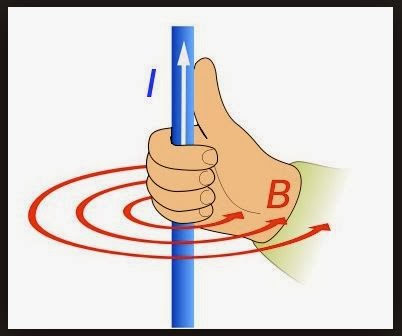
3.    An electric current in a wire creates a circular magnetic field around the wire, its direction (clockwise or counter-clockwise) depending on the direction of the current.

4.    A current is induced in a loop of wire when it is moved towards or away from a magnetic field, or a magnet is moved towards or away from it, the direction of current depending on that of the movement.


Induction:


Electromagnet:
The electricity flowing through the wire arranges the molecules in the nail so that the nail becomes magnetic.  When the current is gone, the nail is no longer magnetic.


Telegraph:


Electric Generator:


Device that converts mechanical energy to electrical energy (by pushing a magnet past a wire). The source of mechanical energy may be a reciprocating or turbine steam engine, water falling through a turbine or waterwheel, an internal combustion engine, a wind turbine, a hand crank, compressed air, or any other source of mechanical energy. Generators provide nearly all of the power for electric power grids.


Nikola Tesla; 10 July 1856 – 7 January 1943, invented AC induction motor.


Thomas Edison, Feb 11, 1847 - Oct 18, 1931 - "The Wizard of Menlo Park"


There are a lot of great youtubes - watch a few!


Breadboards:


Using a multimeter:


Resistors:


Resistor Color Code: