Pages

Showing posts with label HW. Show all posts

Project Report and Proposal


Review “Writing as an Engineer”


Use a writing center to proofread your proposal and report:
http://www.lonestar.edu/tutoring.htm 
Designed for students that have writing assignments in any class, has several computers where you can work on your assignments. 

Proposal→Report
Walk through the engineering design method:  

PGR.BAT.DCCR
  • Define the problem you want to solve
  • List specific goals
  • Include background research on your product
  • List the ideas you brainstormed
  • Analyze & test your ideas
  • Decide what project your group will work on
  • Communicate your choice → Proposal, Report, Final Presentation
  • Commercialize - post it on Kickstarter, or a creative commons site. Share your idea so it does not die at the end of the semester!
  • Review - if you had another 6 months to work on it, what would you change?
~~~~~~~~~~~~~~~~~~~~~~~~~~~~~~~~~


Proposal→Report 
The proposal will turn into your report by the end of the semester.  Even though you have not built anything yet, you should be able to include a sketch of the design, plans on how it will be tested, and have all your background research done in the proposal.


Heading:
Centered on page: Name of your product (pick a catchy name!)
List team member names with their contribution


The No Totter Water Potter
Jack  – Research competition & PR 
Jill – Construction, design sketches 
Mary –  Testing - experimental design, set up data sheets & testing methodologies
Joe – Research problem & technical issues.

ENGR1201, LSC-KW
Semester, 20**


1. Introduction (5 points)
Briefly state the product you decided to create, what need it will fill, who it will be marketed to, and why you chose this product.

ex – Jack and Jill have sustained serious injuries transporting water to their home by hand, so we created a clean drinking water  transportation and containment system.  Fresh spring water from the top of high hill is now safely delivered through insulated polyvinyl chloride piping to sun heated and ground cooled storage tanks located right next to their home. 

2. Research and Background information (10 points)

As can be seen on the map in figure 2.1, on top of High Hill, at the headwater of Slippery Stream, lies Clearwater Spring.   The spring water is purified through a natural filtration process where the groundwater seeps through rocks and soil (1).  This water was last tested on Nov 28, 2016 by AAAEnviroWet and was found to be exceptionally pure (2). →use "insert end-notes" to easily create a numbered reference section.


Use the automatic formatting features in word for your report:
  • Numbered headings and subheadings
  • Figures, tables, and graphs should be referred to and discussed within text.  Use captions and cross-references.  
  • Include a reference section, and (3) add corresponding reference numbers to body of report. 

.
3. Product specifications, diagrams, pictures, and user instructions. (25 points)
Older lead pipes on the High Hill property will need to be removed, and replaced with insulated polyvinyl chloride piping installed according to rhyme building code specifications (4).   A splitter valve will divide the water flow into an above ground black solar hot water pot, and an underground cold water pot where it is stored until needed as shown in figure 3.1.  


4. Testing ,  testing methods, modifications, and operation procedures.   (25 points)
Water purity, pressure, and temperatures were tested throughout the system at various weather conditions as shown in Table 4.1.  ...

Proposal:  Plan out what tests will be performed.  Create data sheets, decide on sample sizes, write testing procedures.


... Fill the rest of the report in by the end of the semester... 

After consideration of the data, a pressure relief valve was installed to prevent rupture of the solar heater during hot summer months, and an air injection line was installed to blow water out of lines susceptible to freeze in the winter.   Operating procedures for both summer, and winter months are presented below….


5. Observations, Results and Discussion (25 points)

The variable water flow rates resulting from seasonal weather changes shown in Table 5.1 were used to calculate the storage tank size needed to ensure a constant water supply through the entire year.   Seasonal weather changes also affected the solar water heater temperatures, and additional  gas or electric heating may be required in winter months.
.
6. Conclusions, suggestions for future work. (10 points)

Jack and Jill’s new “No Totter Water Potter” network is a vast improvement over the previous bucket and muddy path water transportation  system.  Although this new system has many advantages, the spring snowmelt runoff poses a possible threat to water purity in late April and May, and future mitigation for this is strongly suggested.  


Reference Section
Correctly formatted, and numbered.


Project Presentation & Proposal Pitch:
Either make a video advertising what you have created, or post your idea in an online community.  

Presentations should be
Short, sweet, simple, entertaining.

Total presentation should be no longer than 5 minutes.  Post all presentation materials in project D2L drop box & in discussion forum.  Presentations will be graded on enthusiasm, clarity, organization, body language, voice projection, visual aids, content, etc.


Advertise your product!
Create a pitch video.

How to advertise:

1. Tell a story

2. Connect story with a desire to act (desire to buy your product)

3. Use emotional appeals - people are more likely to remember what they are emotionally attached to
eight basic universal emotions:
  •  joy, 
  • surprise, 
  • anticipation, 
  • acceptance, 
  • fear, 
  • anger, 
  • sadness, 
  • disgust. 

4. Use inferences that allow audience to jump to conclusions without you having to say anything.  Use riddles - allow audience to arrive at your correct answer themselves.  

5. Show - rather than tell.  Audience is skeptical about advertisers - what adds do you like?  The adds that are trying to sell something? or the adds that tell a cute story, and just happen to have product placement in it?  Seeing is believing - actions speak louder than words - use pictures, demonstrations.

6. Life is experienced through senses - feel, hear, smell, taste - incorporate all 5 senses into advertisement. 

7.  Coordinate audio and visual messages - keep everyone unified and coordinated with each other.  Disorganized chaotic, not-unified = not impressive.

8.  Pause - use silence - don't rush.

9. Let some things speak for themselves.

10.  Music - poetry - catch phrase - title - name of product


Alternative Uses Test
J.P. Guilford in 1967
Creativity test - in two minutes, come up with as may alternatives uses as you can for a  (fill in the blank - pencil, paperclip, brick, chair, etc.).  

  • responses graded on:
  • Quantity - how many different uses you can come up with
  • Originality
  • Different areas (energy, transportation, food, art, infrastructure - different disciplines)
  • Elaboration - level of detail in response

Apply the alternative use test to your product → more uses = larger audience = more clients

Post it note story - started as spray for a bulletin board (no one wanted the spray), alternative use - tried it as a bookmark → people took the book marks and started writing on them and sticking them on things other than books.  After analyzing user response, the now famous post-it notes were created.  Took many years, and experimenting with many different uses of the glue before it evolved into what it is today!


Example Presentation Eval:
Presentation grade:
50% based on the feedback and quality of comments you give other groups.
50% based on how other groups grade you.


Group: __________________       
Grader: _______________________


PRESENCE                                                                               
5          4          3          2          1          0
      -body language & eye contact
      -poise
     -enthusiasm

LANGUAGE SKILLS                                                             
5          4          3          2          1          0
      -correct usage
      -appropriate vocabulary and grammar
      -understandable (rhythm, intonation, accent)
      -spoken loud enough to hear easily

ORGANIZATION                                                                    
5          4          3          2          1          0
      -clear objectives
      -logical structure
      -signposting ( the way they explain the path that was taken)

MASTERY OF THE SUBJECT                                             
5          4          3          2          1          0
      -pertinence
      -depth of commentary
      -spoken, not read
      -able to answer questions

VISUAL AIDS                                                                          
5          4          3          2          1          0
      - Clear and understandable
      - Demonstrates proficiency in CAD
     

OVERALL IMPRESSION                                                      
5          4          3          2          1          0
      -very interesting / very boring
      -pleasant / unpleasant to listen to
      -very good / poor communication

TOTAL SCORE  _______ / 30


List Strengths:

List at least one area for improvement:


Ethics Presentation

NSPE Code of Ethics for Engineers - link

National Society of Professional Engineers
  • This is one of the documents used for interpreting ethical dilemmas submitted by engineers, public officials, and members of the public. 
  • Use this code to analyze your / engineering ethics case study.  Consider the possible ethics violations, then argue the innocence or guilt of the engineers involved.  What principles were violated? What steps were taken to prevent future failures?
NSPE Board of Ethical Review - link 

Assignment:

  • Imagine you are on the NSPE Board of Ethical Review.  Read through a few previously addressed Ethics cases:
specific cases:
Fill in the short form for access to cases.
http://www.nspe.org/resources/ethics/ethics-resources/board-of-ethical-review-cases#2014

then-

See also:
Risk management: 

Space program accidents: 


As a group, or individually, create a 5 minute long video outlining your chosen engineering ethics case.


 Engineering Case Study Presentation:  

1. Cite the disaster or product recall that you decided to investigate.


2. Briefly list (in bullet form) the facts about the incident.


3. List the ethical issues involved, and prioritize these issues from most critical to least critical.


4. How was the case resolved in real life?  (ie, who lost their job, how much $ were the victims paid, what new regulations were imposed, etc.) Do you agree with outcome on your case?  Should more have been done? less?  Support your answer by citing relevant sections in the Code of Ethics, and through using background info on the resolution of other similar cases.


5. Discuss this case from the perspective of :


a.) The public

b) The company managers

c) The company employees

 6. After this incident was resolved, if you were an authority figure for the company, what steps would you take to ensure future ethics violations would not occur?  


7.  Think about what ethical issues might come up in your chosen field of work.  How do you plan on addressing these issues?  If you find yourself in a dangerous working environment or involved with a project that is taking a bad turn - who can you go to for help?

8. Create a Fault or Event tree of the event.  What risk control measures were taken?  What should have been done?
http://intro1201.blogspot.com/2015/11/risk-management.html


Example presentation:


Note the clear concise slides with large font.  Do not paste your entire report onto your slides, just outline the main points!

Use Large clear images. 
A slide with only one clear image is better than a cluttered slide with a bunch of text and multiple images.  The audience's attention should be on the presenter, not distracted by trying to read and figure out cluttered slides.


Presenters knew the material well enough that they were able to discuss the below images without the need to read text off of slides, so they did not need to clutter the below slides with explanatory text. 


There is probably a little too much text on these two slides, but they still contain good information.


What is the difference between plagiarism and research?
Research work has references - and uses more than one reference!  A common practice is to reserve the last slide for references, "thank you" to contributing groups and people, acknowledgement of companies involved, etc. 

Dynamics HW

The following excel worksheet will be in the discussion area in D2L.  Fill these charts out, then use the same method to create graphs for your actual mousetrap data.   


Mousetrap

Create a mousetrap car for the dynamics lab!


Car that goes the longest distance
does not have to take the final!


Rules:
  • Work on them individually, or in groups of two - if you work in groups, you split the reward if you win (ie - each person gets 50 extra points on final)


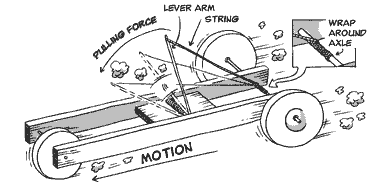
  • Use one mousetrap to propel the car - (do not add electric motors etc. - your car can only be propelled by the mousetrap spring)
 
  • Bring a video camera to record your run (phone)

    • You will use the video to record x(t) to calculate velocities and accelerations from.


Grade:

1. Distance traveled (25 points)
        4 points / ft  
    scores above 25 points get you extra credit

  • 0-1 ft→ 4 points
  • 1-2 ft → 8 points
  • 2-3 ft → 12 points
  • 3-4 ft → 16 points
  • 4-5 ft → 20 points
  • 5-6 ft → 24 points
  • 6-7 ft → 28 points!  (25 + 3 Extra credit)
 
2. Travels in a straight line (20 points)
score = 20 - 10*(Distance from center line / distance traveled)

https://www.youtube.com/watch?v=miHyjbepg8c

3.  Design (30 points)

     Weight: 10 points
    • 0-200 g = 10 points
    • 200-400 g = 8 points
    • 400-600g = 6 points 

      Strength & functionality: 10 points
          Robust Design that doesn't fall apart?
           Smooth operation of parts?

      Aesthetic appeal & creativity: 10 points
              

4. Top speed (25 points)

       top 33% in class - 25 points
     middle - 20 points
     bottom 33% - 15 points


Tips:
Lightweight cars typically go faster & farther.

Do a google image search to see designs.
Make wheels out of:

  • old CD's
  • Records (you can get these at 1/2 priced books for ~ $1.00)
  • Lids from plastic food containers
  • old toy car wheels


We'll test them on the tile surface downstairs so you will need some kind of traction for your wheels:
  • Wrap a rubber band, balloon, or other rubber material around your wheel.


Prior to race-day we will be:
- going through some dynamics concepts

- setting up excel spreadsheets for the data
- going through error propagation examples

Dynamics lab:
You will only need to write up the results section of this lab report, which includes:

  •  x(t), v(t) and a(t) graphs; 
  •  your video
  •  your data
  •  example error propagation calculations.
Last semester's vids if you need data:

and


Example car:
(Thanks  Victor T.!)


Example data set (from above car)


ENGR Disciplines Paper


Engineering Disciplines Paper

Engineering is a broad field that offers many disciplines, each with different specializations.  Identifying the specific disciplines and specializations you want to pursue is essential in planning your academic and professional career.  Does Mechanical Engineering appeal to you?  What about Civil, Electrical, or Industrial? 

Not required, but it might help to organize your thoughts to create an outline and set everything up in technical format (numbered sections, lists, figures) outlining your life plan. 

Section 1:  What are your top 3 engineering discipline choices?
Some majors are more competitive than others, if you can't get into your top choice, consider alternative possibilities.

What is more important to you - your major or your university?
If you are flexible on what university to transfer to, you can keep the major you want.
If you are flexible with your major, you can get into the university you want.

Read through and watch the youtubes on:
  http://intro1201.blogspot.com/2015/02/engineering-majors.html

Don't just pick something because you happen to be familiar with it!  Become familiar with all of the disciplines so you can make an informed choice.

What is the job outlook in your chosen fields like?  What are similar occupations?
http://www.bls.gov/ooh/Architecture-and-Engineering/home.htm


Section 2:  What are your goals in this field? What specializations would you like to go into?  Which of the below squares describes what you want to do?


Section 3:
What are the top 3 universities you would like to transfer to?
What classes do you need to take for the program you want into?
What is your plan for paying tuition? What scholarships are you applying for?
Make sure the program is ABET accredited or your degree will not be worth as much!!
Be specific!  List which classes you will take which semester, list the specific scholarships you are applying for, look at the department and research group you want to join.  What open house events are you planning on attending?  Visit the university before you transfer there!


Visit university websites for up-to-date program information:


http://best-engineering-colleges.com/


http://www.supercollege.com/


http://www.finaid.org/


http://www.lonestar.edu/scholarships.htm


Engineering societies also all have good scholarships:
https://en.wikipedia.org/wiki/List_of_engineering_societies

Section 4:  Where are you sending resumes to for internship opportunities while you are in school?  What career fairs do you plan on attending?  What are the top 4 companies you would like to work for when you are done, and why? 

NSF: http://www.nsf.gov/crssprgm/reu/


http://en.wikipedia.org/wiki/List_of_companies_in_Houston


Start by opening up a google map, and go directly to the websites of the companies near your home!

 http://www.lonestar.edu/career-services.htm


http://www.lonestar.edu/career-fairs.htm


Include references at the end of the paper.

http://www.census.gov/eos/www/naics/
http://en.wikipedia.org/wiki/List_of_companies_in_Houston

Trouble?

Turn in what are able to get through - and I will send you links, and additional resources for anything you are missing.  This is not just an assignment to  trudge through - this kind of thoughtful planning will make the difference between reaching your goals or not!  

Sorry for the long copy and paste, but you need to know the trends going on right now... consider K-12th grade → you have already been in school for a few years... you can last a few more years!    

Stats of incoming college students...
 https://www.citylab.com/work/2017/02/why-millions-of-americans-never-finish-college/517713/

How can millions of Americans be out of work or stuck in low-wage jobs, while employers leave millions of jobs unfilled each year? A big reason is the nation’s college completion crisis—something that is just beginning to get the national attention it deserves... In fact, less than half of America’s college students ever graduate. And the numbers are worse at community colleges, (**it's ok not to get your AS degree - just so long as you transfer!!)  which are the primary providers of education and training for the 29 million middle-skill jobs that pay middle-class wages.
...
Community colleges serve close to half of all American students, enrolling 10 million students each year, but just under 20 percent earn an associate’s degree within three years....(Ask yourself, do you really want to be going part-time?  How long is it going to take you to get through this degree going part time??)

Dismal as these numbers are, they don’t reflect the full extent of the problem, since the statistics exclude students enrolled part-time and those who “stop out”—take a break from school to work or care for family and later return to college. There is anecdotal evidence that completion rates for these students are even lower. (resist the urge to "take a semester off" you will lose your momentum, waste time catching up, and get way behind.  Endurance!  Just keep plowing through it!!) This means that a large swath of America’s potential workforce isn’t getting the education and training they need to support themselves and their families and climb into the middle class.

There are two central reasons that students don’t complete college:
a.) inadequate preparation (Get a D in something? retake it, get the foundation you need from the start or you will be fighting it the entire time through.  That is just fine to take a semester or two to get through leveling courses.)

b.) difficulty navigating college (Talk to Nicole - know what classes you need, and what you do not need.  Plan ahead so you can register the first day registration opens - choose a path, and stick with it!)


The second reason students don’t earn a degree is the difficulty of combining college with other commitments or navigating the higher education system. Close to two-thirds of community college students work to support themselves and their families while in school, and they may be facing homelessness and hunger. Many are single parents, and more than a third are the first in their families to attend college—both factors that can pose major obstacles to graduation. (It's just fine to live with your parents, use FAFSA, take advantage of organizations like HAAM - talk to career services about part-time on-campus jobs, carpool, take online classes to minimize your comute)


Fundamental principle in engineering project management:
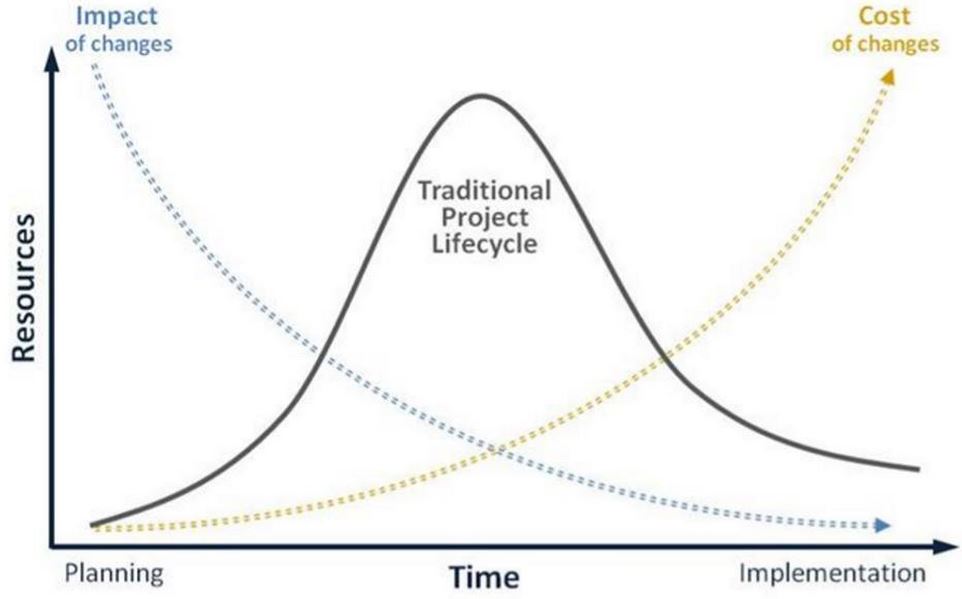
The earlier a needed change is recognized, the more control you have, and the less costly the change is.  As you progress towards the end goal, the cost to change becomes very high, and you lose freedom for making changes.  In other words, make up your mind early on what your end goal is and what your path is - then stick to that path or it will cost you!  Extra effort early on planning everything out is what makes for a successful project.


 Wikinomics.com


THE 7 HABITS OF HIGHLY EFFECTIVE PEOPLE
HABIT 2: BEGIN WITH THE END IN MIND - HTTPS://WWW.STEPHENCOVEY.COM/7HABITS/7HABITS-HABIT2.PHP
So, what do you want to be when you grow up? That question may appear a little trite, but think about it for a moment. Are you--right now--who you want to be, what you dreamed you'd be, doing what you always wanted to do? Be honest. Sometimes people find themselves achieving victories that are empty--successes that have come at the expense of things that were far more valuable to them. If your ladder is not leaning against the right wall, every step you take gets you to the wrong place faster.

Habit 2 is based on imagination--the ability to envision in your mind what you cannot at present see with your eyes. It is based on the principle that all things are created twice. There is a mental (first) creation, and a physical (second) creation. The physical creation follows the mental, just as a building follows a blueprint. If you don't make a conscious effort to visualize who you are and what you want in life, then you empower other people and circumstances to shape you and your life by default. It's about connecting again with your own uniqueness and then defining the personal, moral, and ethical guidelines within which you can most happily express and fulfill yourself. Begin with the End in Mind means to begin each day, task, or project with a clear vision of your desired direction and destination, and then continue by flexing your proactive muscles to make things happen.

One of the best ways to incorporate Habit 2 into your life is to develop a Personal Mission Statement. It focuses on what you want to be and do. It is your plan for success. It reaffirms who you are, puts your goals in focus, and moves your ideas into the real world. Your mission statement makes you the leader of your own life. You create your own destiny and secure the future you envision.

http://spacefem.com/quizzes/engineer/


ENGR advisor:
Nicole Foley, Nicole.D.Foley@lonestar.edu

Please set up an appointment and create a degree and transfer plan with Nicole.  You will need to bring in your transcript, and know your top choices of what schools you would like to transfer to.


Degree curriculum - link
You will need to decide where you are transferring to, and use university transfer guides - not just the LSC AS curriculum!